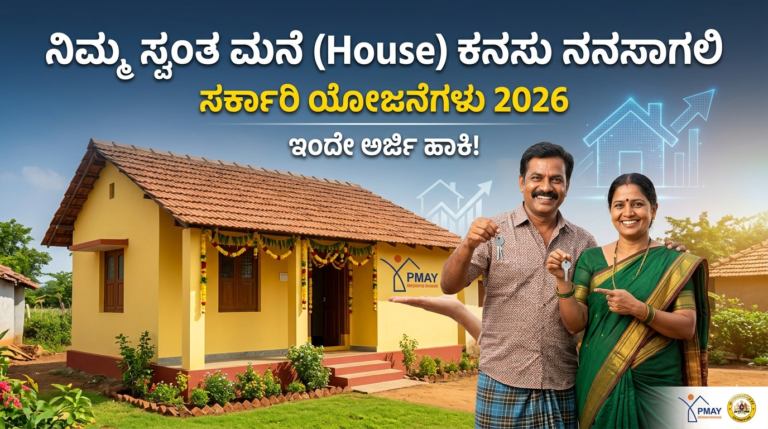
Central and State Government Schemes for House Construction in India 2026
In 2026, the dream of owning a home in India has become more attainable than ever through the evolution of government-backed housing initiatives. With the launch of PMAY-U 2.0 and the extension of PMAY-Gramin, the focus has shifted toward providing sustainable, disaster-resilient, and affordable “pucca” houses to every eligible citizen.
This guide provides a comprehensive breakdown of the active government schemes for house construction in 2026, eligibility criteria, and the direct links to apply.
1. Pradhan Mantri Awas Yojana – Urban 2.0 (PMAY-U 2.0)
PMAY-U 2.0 is the flagship urban housing mission launched to address the housing shortage for the urban poor and middle-class families. The scheme aims to assist 1 crore families over the next five years.
Key Components:
-
Interest Subsidy Scheme (ISS): This is the most popular vertical for the middle class. It provides an interest subsidy of 4% on the first ₹8 lakh of a home loan for up to 12 years. The maximum subsidy benefit is approximately ₹1.80 lakh.
-
Beneficiary Led Construction (BLC): Designed for families who already own land but live in “kutcha” houses. The government provides financial assistance of up to ₹2.5 lakh to build a new house or enhance an existing one.
-
Affordable Housing in Partnership (AHP): Financial assistance is provided to EWS families to buy houses built in partnership with States/UTs or the private sector.
-
Affordable Rental Housing (ARH): Specifically targets urban migrants and industrial workers who do not wish to own a home but need dignified, low-cost rental options near their workplace.
Eligibility Criteria (Urban 2026):
-
Income Slabs: * EWS: Annual income up to ₹3 Lakh.
-
LIG: Annual income between ₹3 Lakh and ₹6 Lakh.
-
MIG: Annual income between ₹6 Lakh and ₹9 Lakh.
-
-
Property Ownership: Neither the applicant nor any family member should own a pucca house anywhere in India.
-
Women Empowerment: Preference (and in some cases mandatory requirement) is given to female head-of-the-family as the owner or co-owner.
Apply Link (Urban): https://pmay-urban.gov.in/
2. Pradhan Mantri Awas Yojana – Gramin (PMAY-G) 2.0
For rural India, the PMAY-G has been extended with a fresh target of constructing 2 crore additional houses by 2029.
Key Features:
-
Financial Grant: Eligible beneficiaries receive ₹1.20 lakh in plain areas and ₹1.30 lakh in hilly/difficult areas (North-Eastern states, Himalayan states, and UTs like J&K).
-
-
Labor Support: Beneficiaries are also entitled to 90–95 days of unskilled labor wages under MGNREGA.
-
Sanitation Grant: An additional ₹12,000 is provided for toilet construction through Swachh Bharat Mission (Gramin).
-
House Quality: The minimum size of the house is 25 sq. m. including a dedicated area for hygienic cooking.
Eligibility & Selection:
-
-
Unlike the urban scheme, rural beneficiaries are identified through the Awaas+ 2024 survey and Socio-Economic Caste Census (SECC) data. The list is then verified by the Gram Sabha to ensure only the truly needy are included.
Official Portal: https://pmayg.nic.in/
3. State-Specific Housing Schemes
Many state governments run parallel housing schemes that can sometimes be combined with PMAY benefits.
-
MHADA (Maharashtra): Conducts lottery-based allotment for affordable apartments in cities like Mumbai and Pune.
-
DDA Housing Scheme (Delhi): Offers flats across various categories (EWS to HIG) in the national capital.
-
Namma Mane (Karnataka): A state-specific initiative focused on providing housing to the economically backward sections in Karnataka.
-
HUDA (Haryana): Provides residential plots and flats at subsidized rates.
-
How to Apply Online in 2026: Step-by-Step
Applying for a housing scheme has been simplified through digital portals. Follow these steps:
-
Check Eligibility: Visit the official PMAY portal and use the “Eligibility Calculator” based on your annual household income.
-
Aadhaar Verification: Navigate to the “Citizen Assessment” section. Enter your Aadhaar number and name as per Aadhaar.
-
Fill the Application: Complete the detailed form including personal details, bank account info, and income details.
-
-
Upload Documents: You will need scanned copies of your Identity Proof, Address Proof, Income Certificate, and an Affidavit stating you do not own a pucca house.
-
Save & Submit: After filling the form, save it and note down the Assessment ID for tracking.
Direct Application Tracking Link: https://pmaymis.gov.in/Track_Application_Status.aspx
-
Required Documents Checklist
-
Aadhaar Card (Mandatory for all family members).
-
Income Certificate or Salary Slips/ITR.
-
Voter ID / PAN Card for identity.
-
Bank Passbook (to receive the subsidy/grant via DBT).
-
Caste Certificate (if applying under SC/ST/OBC category).
-
Property Documents (if applying for Beneficiary Led Construction).
| Scheme | Target Area | Max Subsidy/Grant | Eligibility (Income) |
| PMAY-Urban 2.0 | Cities/Towns | ₹1.80 Lakh (Interest Subsidy) | Up to ₹9 Lakh p.a. |
| PMAY-Gramin | Villages | ₹1.20 – ₹1.30 Lakh (Direct Grant) | Based on SECC/Awaas+ |
| CLSS 2026 | Urban | 4% Interest Subvention | EWS, LIG, MIG |
| State Boards | State-Specific | Varies by State | Varies |